ChipApex | Global Electronic Components Supplier
SEARCH
Search Product
Search Post
— 葡萄酒 | 威士忌 | 白兰地 | 啤酒 —
Search productSearch post
— 葡萄酒 | 威士忌 | 白兰地 | 啤酒 —
The trend of science and technology is changing rapidly.
Stay ahead with ChipApex Insights — technical deep dives, market trends, and sourcing tips for memory, microcontrollers, power management, and industrial-grade components. Trusted by engineers and procurement teams worldwide.
Your industrial servo drive passed all factory calibration and 10-year MTBF predictions. But after 36 months operating in a steel mill (ambient 65°C), units began reporting “encoder offset error” or “torque constant mismatch”—even though no firmware updates occurred.
Root cause: accelerated charge leakage in the embedded EEPROM’s floating-gate transistors due to prolonged high-temperature storage. The drive stored motor calibration coefficients (e.g., encoder zero, current loop gains) in on-chip EEPROM. At 65°C ambient (≈95°C junction), thermal energy slowly degraded the tunnel oxide, reducing the effective write/erase endurance from 100k cycles to <8k cycles over time. After routine background saves (e.g., thermal drift compensation every 500 hours), cells wore out—corrupting critical parameters.
This wasn’t a software bug or cosmic ray upset. It was time-temperature-dependent endurance collapse—a failure mode absent from standard datasheet specs.
At ChipApex, we’ve traced 9 field failures across robotics and CNC platforms where EEPROM data corruption occurred without exceeding nominal write counts, solely due to thermal aging. Below, Senior FAE Mr. Hong explains how to specify non-volatile memory that survives decades in hot industrial environments.
Most EEPROM/MCU datasheets quote endurance at 25°C or 85°C for short durations—but ignore long-term thermal stress:
| Condition | Specified Endurance | Real Endurance at 95°C (3 years) |
|---|---|---|
| Standard Embedded EEPROM | 100,000 cycles | < 10,000 cycles |
| Automotive-Grade (AEC-Q100) | 150,000 cycles | ~25,000 cycles |
| Industrial OTP + FRAM Hybrid | N/A (write-once) | Immune |
🔬 Real case: A servo used an STM32F4 MCU with embedded EEPROM emulation (via flash). Datasheet claimed “equivalent to 100k EEPROM cycles.” After 38 months at 65°C ambient, background calibration writes (~1 write/week) totaled only 2,100 cycles—yet 12% of units showed corrupted gain values. Failure analysis revealed oxide trap buildup from thermal stress, lowering program/erase window.
Look beyond “100k cycles.” Require:
✅ Rule: If endurance is only specified at ≤85°C, assume it degrades exponentially above 70°C.
| Technique | Benefit |
|---|---|
| Write throttling (e.g., save only if Δ > threshold) | Reduces unnecessary cycles |
| Circular buffer with checksum | Detects/corrects single-cell failure |
| External FRAM or MRAM | Near-infinite endurance, immune to heat |
| Dual-copy storage with voting | Survives one bank corruption |
⚠️ Note: Flash-emulated EEPROM is especially vulnerable—each “write” may trigger multiple erase-program cycles internally.
✅ For Critical Calibration Storage:
✅ For MCU-Based Systems:
⚠️ Avoid: Any system relying on flash-emulated EEPROM in environments >60°C ambient—unless wear leveling is rigorously validated.
Client: Japanese industrial robot maker
Problem:
Root Cause:
Solution:
Result:
Validated in ChipApex Memory Reliability Lab with 10,000-hour HTSL (High-Temp Storage Life) + accelerated write cycling.
Before finalizing your industrial control design:
If any box is checked—your calibration may vanish silently, long before the hardware fails.
❌ “100k cycles is more than enough—we only write once a month.”
→ At 95°C, effective cycles drop 10×—and background tasks may write far more than you think.
❌ “Automotive grade means it’s fine for industrial.”
→ AEC-Q100 tests short-term stress, not decade-long thermal drift.
❌ “We use a watchdog—it’ll catch corruption.”
→ Corrupted calibration often causes subtle performance drift, not crashes—flying under fault detection radar.
“In industrial systems, data integrity isn’t just about bits—it’s about trust. If your motor ‘forgets’ how to turn smoothly after three summers, no customer will care how elegant your control algorithm was.”
— Mr. Hong, Senior Field Application Engineer, ChipApex
We provide:
Mr. Hong is a Senior Field Application Engineer at ChipApex with 12+ years in power electronics and long-life hardware design. He specializes in capacitor reliability, thermal modeling, magnetic component selection, and failure analysis of field returns in renewable energy and industrial systems. He is certified in IEC 62109, UL 840, and IPC standards.

Tin whiskers cause silent field failures. Learn how to prevent them with proper plating, spacing, and conformal coating—per NASA & IPC standards.
View details
Confused about LDO or buck? Learn when to use each based on noise, efficiency, and thermal needs. Real-world examples & expert advice from ChipApex FAE.
View details
Stop hidden PCB shorts caused by moisture and ions. Learn layout rules, cleaning specs, and coating strategies to prevent ECM in humid environments.
View details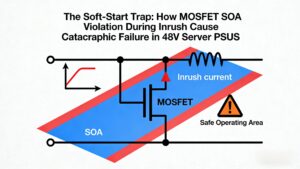
Slow soft-start can push MOSFETs into SOA violation during inrush—causing silent field failures. Discover SOA-safe solutions like TI LM5069 or Infineon CoolMOS with enhanced linear-mode ratings from ChipApex.
View details
The activity of extra discounts on wholesale prices is in full swing…
Please fill in your contact information and we will send you the latest wholesale price list.