ChipApex | Global Electronic Components Supplier
SEARCH
Search Product
Search Post
— IC芯片 | 连接器 | 传感器 | 被动器件 —
Search productSearch post
— IC芯片 | 连接器 | 传感器 | 被动器件 —
The trend of science and technology is changing rapidly.
Your industrial gateway passed ESD and EFT tests—then failed the first 1kV surge pulse on its 48V RS-485 port. The TVS diode exploded, taking the transceiver with it. Why? You treated surge like ESD: a single-component problem. But IEC 61000-4-5 delivers high-energy, long-duration pulses (1.2/50 µs voltage wave + 8/20 µs current wave)—requiring a system-level defense.
At ChipApex, we’ve helped clients turn repeated surge failures into first-pass compliance. In this guide, Senior FAE Mr. Hong reveals how to design robust, cost-effective surge protection for 12V–48V industrial interfaces (RS-485, CAN, Ethernet PoE, digital I/O) that survive Level 3 (2kV/1kA) and beyond.
A typical “protection” circuit:
[48V Line] ──┬──[TVS Diode]── GND
└──[RS-485 IC]Problem:
🔥 Measured data: A SMAJ58A (600W) subjected to 1kV/0.5kA surge:
- Clamped voltage: 92V (too high for 48V ICs!)
- Failed after 2 pulses due to thermal runaway
Effective surge protection requires energy handling + voltage clamping + isolation:
✅ Use GDT for AC mains-coupled surges; TBU for DC industrial lines (faster, no follow-on current).
[48V Line] ──[GDT/TBU]──[TVS]──[Ferrite]──[RS-485]──[Isolator]──[MCU]
│ │
GND1 GND2 (separate!)⚠️ Critical: Separate GND1 (surge side) and GND2 (logic side) with ≥2 mm gap or slot.
Client: AMI (Advanced Metering Infrastructure) provider
Requirement: Pass IEC 61000-4-5 Level 3 (2kV line-earth) on 48V PLC communication port
Initial design:
Result:
Solution:
Test result:
All parts sourced via ChipApex with surge test reports.
Even the best components fail with poor layout:
✅ Do:
❌ Don’t:
📏 Pro Tip: Minimize loop area between line and ground—this reduces radiated EMI during surge too.
| Function | Recommended Part | Key Spec |
|---|---|---|
| Stage 1 (Energy Diversion) | Bourns TBU-CA065-200-WH | 65V, 200mA hold, solid-state |
| Littelfuse CG100-100LF | 100V GDT, 10kA | |
| Stage 2 (Clamping) | Vishay SMCJ48A | 1500W, Vc=77.4V |
| Littelfuse SMBJ48CA | 600W (only for ≤1kV) | |
| Isolation | Silicon Labs Si8620BD-B-IS | 2.5kVRMS, 150 Mbps |
| TI ISO1540 | I²C isolator for config lines |
💡 Cost vs Performance:
- For 1kV: TVS + ferrite may suffice
- For 2kV+: Always use TBU/GDT + TVS + isolation
❌ “My TVS is rated 600W—it can handle surge.”
→ 600W is peak pulse power for 1ms, not 20µs surge. Real surge energy is much higher.
❌ “I passed ESD, so I’ll pass surge.”
→ ESD = nanosecond, millijoule event. Surge = microsecond, joule-level event. Totally different physics.
❌ “Ground is ground—no need to split.”
→ Surge current raises local ground by hundreds of volts—enough to kill logic ICs.
❌ “The standard says ‘line-earth’—so I only protect to earth.”
→ Also test line-line! Many systems fail there due to common-mode conversion.
“Surge protection isn’t about the strongest TVS—it’s about managing energy flow. Think like a plumber: divert the flood, then clean the trickle.”
— Mr. Hong, Senior Field Application Engineer, ChipApex
We provide:
Mr. Hong is a Senior Field Application Engineer at ChipApex with over 12 years of experience in industrial system robustness, EMC design, and failure analysis. He has supported clients in smart grid, factory automation, and building management systems in achieving global EMC certifications (CE, FCC, KC, CCC). At ChipApex, he leads technical validation for surge, ESD, and EFT protection strategies and advises on cost-effective compliance for mass-deployed edge devices.

Nanohenry gate loop inductance in GaN drivers causes false turn-on and shoot-through at low temperatures. Discover Kelvin-source layouts, ferrite damping, and robust solutions like EPC2067—validated by ChipApex in automotive 48V systems.
View details
Stop USB-C port failures. Learn CC line protection, VBUS eFuse selection, and PCB layout rules for ±8kV ESD immunity.
View details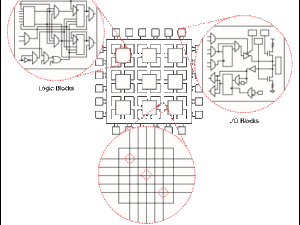
Comprehensive analysis of FPGA Logic Array Block (LAB) structure, including core components of LUTs, flip-flops, multiplexers, and local/cascade interconnects. Master the architecture design principles to optimize FPGA resource utilization and per...
View details
Propagation delay mismatch in optocouplers erodes dead time, causing shoot-through in SiC inverters. Discover low-skew solutions like TI UCC23513 or Silicon Labs Si823Hx—validated by ChipApex in 300kW field systems.
View details
The activity of extra discounts on wholesale prices is in full swing…
Please fill in your contact information and we will send you the latest wholesale price list.