ChipApex | Global Electronic Components Supplier
SEARCH
Search Product
Search Post
— IC芯片 | 连接器 | 传感器 | 被动器件 —
Search productSearch post
— IC芯片 | 连接器 | 传感器 | 被动器件 —
The trend of science and technology is changing rapidly.
Field-Programmable Gate Arrays (FPGAs) are highly versatile integrated circuits that can be configured to perform a wide range of digital functions. A key component of an FPGA’s architecture is the Logic Array Block (LAB), which serves as the fundamental building block for implementing logical operations. Understanding the structure of LABs is essential for grasping how FPGAs achieve their flexibility and performance.
Logic Array Blocks are composed of several essential elements that work together to execute logical functions. These elements are carefully designed to provide a balance between functionality, speed, and resource utilization.
At the core of each LAB are Lookup Tables (LUTs). LUTs are small memory units that store the truth tables of logical functions. For example, a 4-input LUT can implement any function of four binary variables, resulting in 16 possible output combinations (2^4). By programming the LUT with the appropriate truth table values, designers can define the logical behavior of the LAB.
LUTs offer several advantages. They are highly flexible, allowing for the implementation of complex logical functions without the need for multiple discrete gates. Additionally, LUTs can be easily reconfigured, enabling the FPGA to adapt to different tasks or requirements. The size of the LUT, typically measured by the number of inputs, varies depending on the FPGA architecture, with common sizes including 4-input, 6-input, and even larger LUTs in more advanced designs.
In addition to LUTs, LABs often contain flip-flops and latches, which provide sequential logic capabilities. Flip-flops are edge-triggered devices that store a single bit of data and change their state only at specific clock edges (rising or falling). Latches, on the other hand, are level-sensitive devices that can change their state as long as the enable signal is active.
These sequential elements enable LABs to perform operations that require memory, such as counting, shifting, and storing intermediate results. By combining LUTs with flip-flops and latches, designers can create complex state machines and sequential circuits within the FPGA. The ability to configure these sequential elements allows for a wide range of timing and control functions, making FPGAs suitable for applications that demand precise synchronization and sequencing.
Multiplexers (MUXes) are another important component found within LABs. MUXes are digital switches that select one of several input signals and route it to a single output. They are used to control the flow of data within the LAB, allowing for flexible signal routing and selection.
For example, a 2-to-1 MUX has two input lines, one select line, and one output line. The value on the select line determines which of the two input signals is passed to the output. By cascading multiple MUXes, designers can create more complex selection circuits, enabling the LAB to perform a variety of data manipulation tasks. MUXes are essential for implementing functions such as data routing, conditional operations, and signal multiplexing, which are common in digital circuit design.
The elements within a LAB are not isolated; they are interconnected through a network of programmable interconnects. These interconnects allow signals to flow between LUTs, flip-flops, latches, and MUXes, enabling the LAB to perform complex logical operations.
Local interconnects are short-distance connections that link the components within a single LAB. They provide low-latency signal paths, allowing for fast communication between the LUTs, flip-flops, and other elements. Local interconnects are typically implemented using metal wires on the FPGA chip, with programmable switches that can be configured to establish or break connections as needed.
The use of local interconnects ensures that signals within a LAB can be processed quickly and efficiently, minimizing delays and improving overall performance. This is particularly important for high-speed applications where timing is critical, such as digital signal processing and high-frequency trading.
In addition to local interconnects, LABs may also feature cascade interconnects, which allow signals to be passed from one LAB to another in a sequential manner. Cascade interconnects enable the implementation of larger logical functions that cannot be accommodated within a single LAB.
By cascading multiple LABs, designers can create complex circuits that span multiple blocks on the FPGA. This approach provides a scalable solution for implementing large-scale digital functions, such as arithmetic units, memory controllers, and communication interfaces. Cascade interconnects are typically designed to support high-speed data transfer between LABs, ensuring that signals can be propagated quickly and reliably across the FPGA.
One of the key advantages of FPGA LABs is their high degree of configurability. The ability to program the LUTs, flip-flops, latches, and interconnects allows designers to tailor the LABs to specific application requirements.
As mentioned earlier, LUTs are programmed by loading the appropriate truth table values into their memory cells. This programming can be done during the FPGA configuration process, which typically occurs at power-up or through a dedicated configuration interface. By changing the values stored in the LUTs, designers can redefine the logical functions performed by the LABs, enabling the FPGA to adapt to different tasks or algorithms.
Flip-flops and latches within the LABs can also be configured to operate in different modes. For example, designers can choose between rising-edge or falling-edge triggering for flip-flops, or select the enable conditions for latches. This flexibility allows for the implementation of a wide range of sequential circuits, from simple counters to complex state machines.
The programmable interconnects within the LABs provide another layer of flexibility. By configuring the switches that control the interconnects, designers can establish custom signal paths between the different elements of the LAB. This allows for the optimization of signal routing, minimizing delays and reducing resource contention. Additionally, the ability to reconfigure the interconnects enables the FPGA to be dynamically rewired, making it possible to adapt to changing application requirements or to implement different functions at different times.
In conclusion, the structure of Logic Array Blocks in FPGAs is a carefully designed combination of Lookup Tables, flip-flops, latches, multiplexers, and programmable interconnects. These elements work together to provide a highly flexible and configurable platform for implementing digital functions. By understanding the composition and interconnectivity of LABs, designers can leverage the full potential of FPGAs to create innovative and efficient solutions across a wide range of applications.
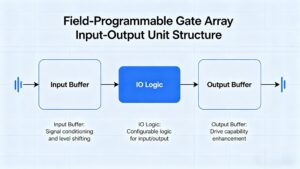
A detailed guide to FPGA I/O unit structure, including input buffers, output drivers, I/O banks, electrical configuration, signal integrity and protection features for engineers.
View details
As the backbone of modern technology, electronic components are undergoing revolutionary changes, driven by advancements in materials science, miniaturization, and smart manufacturing. From ultra-efficient semiconductors to self-diagnosing circ...
View details
Learn a 3-stage surge protection strategy for RS-485, CAN, and 48V I/O that passes 2kV IEC 61000-4-5. Includes layout rules, component selection, and real fixes.
View details
High-temp storage silently degrades EEPROM endurance, corrupting motor calibration in industrial drives. Discover thermally stable solutions like Cypress FRAM or Everspin MRAM—validated by ChipApex in 3-year field studies.
View details
The activity of extra discounts on wholesale prices is in full swing…
Please fill in your contact information and we will send you the latest wholesale price list.