ChipApex | Global Electronic Components Supplier
SEARCH
Search Product
Search Post
— IC芯片 | 连接器 | 传感器 | 被动器件 —
Search productSearch post
— IC芯片 | 连接器 | 传感器 | 被动器件 —
The trend of science and technology is changing rapidly.
Field – Programmable Gate Arrays (FPGAs) are highly versatile integrated circuits that offer immense flexibility in digital circuit design. One of the key features that contribute to this flexibility is the programmable interconnect resources. These resources enable the customization of signal paths within the FPGA, allowing for the implementation of a wide variety of digital functions. Let’s explore the different aspects of programmable interconnect resources in FPGAs.
Short – range interconnects are used to establish connections between neighboring logic elements within a small area of the FPGA. These interconnects are typically implemented using metal wires with programmable switches. The programmable switches can be configured to either connect or disconnect the wires, enabling the creation of custom signal paths.
For example, in a region where multiple lookup tables (LUTs) and flip – flops are located, short – range interconnects can be used to route signals between them. This allows for the efficient implementation of local logic functions, such as arithmetic operations or simple state machines. The advantage of short – range interconnects is their low latency, as the signal has to travel only a short distance, reducing the overall propagation delay.
Long – range interconnects are designed to connect different regions or blocks within the FPGA. These interconnects are longer and more complex compared to short – range interconnects. They often span multiple rows or columns of logic elements and may involve multiple levels of routing.
Long – range interconnects are crucial for implementing large – scale digital functions that require communication between different parts of the FPGA. For instance, in a complex digital signal processing system, different processing units located in different regions of the FPGA need to exchange data. Long – range interconnects provide the necessary signal paths for this data transfer, ensuring that the overall system can function correctly. Although they have higher latency compared to short – range interconnects, their ability to connect distant parts of the FPGA makes them indispensable.
Global interconnects are used to distribute clock signals, reset signals, and other global control signals throughout the FPGA. These signals need to reach all parts of the FPGA simultaneously or with minimal skew. Global interconnects are typically implemented using dedicated high – speed wires that are designed to minimize signal propagation delays.
Clock signals, in particular, are critical for the proper operation of sequential logic elements such as flip – flops. Global interconnects ensure that the clock signal is distributed evenly across the FPGA, preventing timing issues such as clock skew. Reset signals are also distributed using global interconnects to ensure that all flip – flops and other sequential elements are initialized to a known state at the start of operation.
The programmability of interconnect resources in FPGAs is achieved through the use of programmable switches. These switches are typically implemented using transistors or other semiconductor devices that can be configured to either conduct or block the flow of electrical signals.
During the FPGA configuration process, the state of these programmable switches is set according to the design requirements. For example, if a signal needs to be routed from one logic element to another, the corresponding programmable switches along the desired path are configured to be in the conducting state, while other switches are set to the non – conducting state. This allows for the creation of custom signal paths that are tailored to the specific application.
The configuration of programmable switches is stored in configuration memory cells within the FPGA. These memory cells are typically implemented using static random – access memory (SRAM) technology. The values stored in the configuration memory cells determine the state of the programmable switches and, consequently, the signal paths within the FPGA.
When the FPGA is powered on, the configuration memory is loaded with the design – specific data, which programs the interconnect resources and other components of the FPGA. This process allows the FPGA to be reconfigured multiple times, enabling it to adapt to different applications or design changes without the need for physical hardware modifications.
The design of programmable interconnect resources has a significant impact on the signal propagation delay within the FPGA. Short – range interconnects generally have lower propagation delays due to their shorter length and simpler structure. Long – range interconnects, on the other hand, may introduce higher delays, especially if the signal has to travel through multiple levels of routing.
To minimize signal propagation delays, FPGA designers use techniques such as optimizing the routing algorithm, reducing the number of intermediate switches, and using high – speed wires for critical signal paths. By carefully designing the interconnect architecture, it is possible to achieve high – performance digital circuits on the FPGA.
Programmable interconnect resources also contribute to the overall power consumption of the FPGA. The programmable switches consume power when they are in the conducting state, and the length and complexity of the interconnects affect the amount of power required for signal transmission.
Long – range interconnects and global interconnects, which are often used for high – speed signal transmission, can consume a significant amount of power. To reduce power consumption, FPGA designers may use techniques such as power – gating, where unused interconnects are turned off to save power, and optimizing the interconnect layout to minimize the length of signal paths.
The efficient use of programmable interconnect resources is crucial for optimizing the resource utilization of the FPGA. Poorly designed interconnects can lead to congestion, where multiple signals try to use the same interconnect resources simultaneously, resulting in performance degradation.
To avoid congestion, FPGA designers use advanced routing algorithms that can automatically route signals through the available interconnect resources in an optimal way. Additionally, designers can also use techniques such as pipelining and parallel processing to reduce the demand on the interconnect resources and improve the overall performance of the FPGA.
In conclusion, programmable interconnect resources are a fundamental part of FPGAs, enabling their high degree of flexibility and customization. By understanding the different types of interconnects, their programmability, and their impact on FPGA performance, designers can create efficient and high – performance digital circuits on these versatile devices.
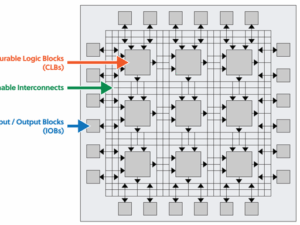
Explore the core of FPGAs - Configurable Logic Blocks (CLBs). Learn about LUTs, flip-flops, multiplexers, their configuration methods, and how CLBs impact FPGA logic density, speed, and power consumption. Essential guide for FPGA designers.
View details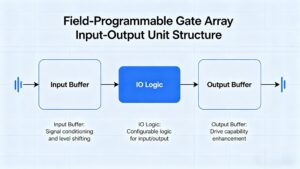
A detailed guide to FPGA I/O unit structure, including input buffers, output drivers, I/O banks, electrical configuration, signal integrity and protection features for engineers.
View details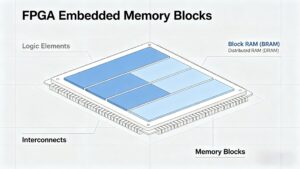
Explore the architectural foundations, operational modes (RAM, FIFO, CAM), performance optimization and error correction mechanisms of FPGA embedded memory blocks, helping engineers design high-performance low-latency systems.
View details
Selecting the right TVS diode? Learn how clamping voltage, capacitance, and layout affect ESD protection on USB, HDMI & more. Expert guide from ChipApex FAE.
View details
Avoid BLE dropouts, GNSS errors, and LTE sync failures with proper clock tree design. Learn layout rules, component selection, and real fixes.
View details
Learn a 3-stage surge protection strategy for RS-485, CAN, and 48V I/O that passes 2kV IEC 61000-4-5. Includes layout rules, component selection, and real fixes.
View details
Learn practical passive cooling techniques for IP67 outdoor electronics: conductive paths, enclosure choice, and power reduction. By ChipApex FAE.
View details
The activity of extra discounts on wholesale prices is in full swing…
Please fill in your contact information and we will send you the latest wholesale price list.