ChipApex | Global Electronic Components Supplier
SEARCH
Search Product
Search Post
— IC芯片 | 连接器 | 传感器 | 被动器件 —
Search productSearch post
— IC芯片 | 连接器 | 传感器 | 被动器件 —
The trend of science and technology is changing rapidly.
Principles of Embedded Memory Blocks in Field-Programmable Gate Arrays (FPGAs)
Field-Programmable Gate Arrays (FPGAs) integrate configurable logic with embedded memory blocks, enabling flexible, high-performance designs for applications like data processing, networking, and AI acceleration. Embedded memory blocks, a critical component of modern FPGAs, provide on-chip storage with low latency and high bandwidth, eliminating the need for external memory in many cases. Below, we explore the architectural principles, operational modes, and performance optimization techniques of these embedded memory resources.
Embedded memory blocks in FPGAs are typically implemented as static random-access memory (SRAM) arrays due to their fast access times and reconfigurability. These blocks are distributed across the FPGA fabric, often organized into columns or rows adjacent to logic resources like look-up tables (LUTs) and digital signal processing (DSP) slices. Key architectural features include:
For example, a 36 Kb embedded memory block in a modern FPGA might be partitioned into smaller sub-blocks (e.g., 18 Kb each) to serve multiple functions simultaneously, such as storing coefficients for a DSP filter while buffering input data.
Embedded memory blocks in FPGAs support multiple operational modes, allowing designers to tailor their behavior to specific requirements. Common modes include:
Advanced FPGAs may also support shift register modes, where data is sequentially shifted through the memory block, or ROM emulation for storing pre-defined constants. The ability to switch between modes dynamically—often through partial reconfiguration—adds another layer of adaptability.
To maximize the efficiency of embedded memory blocks, designers employ several optimization strategies:
For instance, in a high-speed networking application, interleaving four 9 Kb memory banks can achieve a sustained bandwidth of over 100 Gbps, rivaling external memory solutions while reducing latency and power consumption.
Reliability is a key concern for embedded memory, especially in safety-critical applications like automotive or aerospace systems. FPGAs address this through:
These mechanisms are often configurable, allowing designers to balance reliability with area and power overhead based on application requirements.
Conclusion
Embedded memory blocks are a cornerstone of FPGA versatility, combining reconfigurable SRAM arrays with flexible operational modes to meet diverse design needs. By understanding their architectural principles, mode flexibility, and optimization techniques, engineers can leverage these resources to create high-performance, low-latency systems without relying on external memory. As FPGA technology evolves, embedded memory blocks continue to expand in capacity and capability, enabling innovations in areas like edge computing, 5G, and autonomous systems.
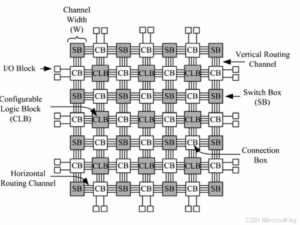
Explore FPGA programmable interconnect resources, including short-range, long-range & global types, programmability principles, and their impacts on signal delay, power consumption & resource utilization. Learn FPGA interconnect basics.
View details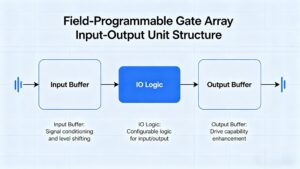
A detailed guide to FPGA I/O unit structure, including input buffers, output drivers, I/O banks, electrical configuration, signal integrity and protection features for engineers.
View details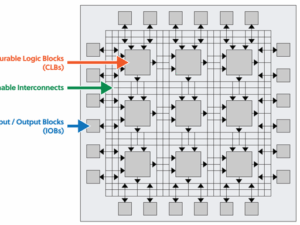
Explore the core of FPGAs - Configurable Logic Blocks (CLBs). Learn about LUTs, flip-flops, multiplexers, their configuration methods, and how CLBs impact FPGA logic density, speed, and power consumption. Essential guide for FPGA designers.
View details
Learn how to design ultra-low-leakage battery backup circuits that last 10+ years in smart meters and industrial systems. By ChipApex FAE.
View details
A perfect storm of surging demand and supply chain disruptions is roiling the global electronic components market, with advanced semiconductors and critical materials now as scarce as gold, while Chinese manufacturers are seizing opportunities to...
View details
Explore the core of FPGAs - Configurable Logic Blocks (CLBs). Learn about LUTs, flip-flops, multiplexers, their configuration methods, and how CLBs impact FPGA logic density, speed, and power consumption. Essential guide for FPGA designers.
View details
Negative ringing on gate drivers causes false MOSFET turn-on and shoot-through in 800V EV inverters. Discover robust solutions like Infineon 1ED3461 with active Miller clamp—validated per ISO 26262 by ChipApex.
View details
The activity of extra discounts on wholesale prices is in full swing…
Please fill in your contact information and we will send you the latest wholesale price list.