ChipApex | Global Electronic Components Supplier
SEARCH
Search Product
Search Post
— 葡萄酒 | 威士忌 | 白兰地 | 啤酒 —
Search productSearch post
— 葡萄酒 | 威士忌 | 白兰地 | 啤酒 —
The trend of science and technology is changing rapidly.
Your BMS monitors cell voltage, temperature, and current—so it’s “safe,” right? Not necessarily. A single undetected overvoltage fault can trigger thermal runaway. Yet adding triple-redundant ADCs and dual lockstep MCUs might blow your BOM by $8 and delay certification by 9 months.
The truth? Functional safety isn’t about redundancy—it’s about risk-aligned architecture. At ChipApex, we’ve helped 17 BMS teams achieve ISO 26262 ASIL-B compliance with minimal hardware overhead. In this guide, Senior FAE Mr. Hong shows how to build a proportionate safety system that passes audit—and scales to production.
Common pitfalls:
🔍 Reality check: For a 48V energy storage system (ESS), the worst-case hazard is fire—not fatality. So ASIL-B is often sufficient, not ASIL-C/D.
Don’t guess safety levels—calculate them.
表格
| Parameter | Typical BMS Scenario |
|---|---|
| S (Severity) | S3 (life-threatening injury) |
| E (Exposure) | E2 (probable, e.g., daily use) |
| C (Controllability) | C2 (driver/operator may not react in time) |
→ ASIL = ASIL-B (per ISO 26262 Table A.1)
✅ Key insight: If your system has automatic disconnect + remote monitoring, you may argue C1 → downgrades to QM or ASIL-A.
ISO 26262 allows splitting high-ASIL requirements into lower-ASIL elements—if you manage dependencies.
Example: Cell Overvoltage Detection (Target: ASIL-B)
Instead of one ASIL-B ADC:
[Cell Voltage] ──┬──[ADC_A (ASIL-A)]──┐
└──[ADC_B (ASIL-A)]──┤ → Voting Logic → Safe State
└──[Comparator (QM)]Requirements:
Result: Achieves ASIL-B equivalent with two ASIL-A components → saves cost, simplifies supply chain.
💡 Pro tip: Use TI BQ76952 or ADI LTC6813-1—they include built-in redundancy and diagnostics for ASIL-B.
Focus on high-risk failure modes with highest probability:
| Failure Mode | Diagnostic Strategy | Coverage |
|---|---|---|
| ADC drift/failure | Cross-check with window comparator + periodic self-test | 95% |
| Open-wire thermistor | Bias current + impedance check | 98% |
| Communication error | CRC + timeout + sequence number | 99% |
| MCU lockup | Independent watchdog (e.g., TPS3851) | 90% |
✅ Total diagnostic coverage: >90% → meets ASIL-B requirement (per ISO 26262 Part 5)
Avoid: Redundant CAN transceivers (low risk), triple-core MCUs (overkill for ASIL-B).
Client: 48V/100Ah lithium iron phosphate (LFP) energy storage unit
Requirement: Pass ISO 26262 ASIL-B for EU market entry
Initial design:
Problem: Certification stalled due to inadequate FMEDA and unjustified redundancy.
Solution:
Result:
All components sourced via ChipApex with ISO 26262 documentation.
✅ Do:
❌ Don’t:
⚠️ Remember: Functional safety = process + product. You need requirements traceability, change control, and validation evidence—not just circuits.
| Function | Recommended Part | Safety Documentation |
|---|---|---|
| AFE (Analog Front End) | TI BQ76952 | ASIL-B FMEDA, FIT rate |
| ADI LTC6820 + LTC6813-1 | Safety manual, diagnostic guide | |
| MCU | Infineon AURIX™ TC2xx | ISO 26262 compliant, ASIL-D capable |
| NXP S32K144 | ASIL-B support package | |
| Watchdog | TI TPS3851 | Independent reset, <100ms timeout |
| Isolation | Silicon Labs Si864x | 5kVRMS, safety-certified |
💡 Cost tip: For non-automotive (e.g., ESS), QM parts with external safety mechanisms often suffice—avoid paying for ASIL-rated silicon unnecessarily.
❌ “If my IC says ‘ASIL-ready,’ I’m compliant.”
→ The system must be safe—not just the chip. Integration matters.
❌ “More redundancy = higher safety.”
→ Unmanaged redundancy increases complexity → higher chance of integration errors.
❌ “We’ll handle safety in software.”
→ Software can’t catch hardware latent faults. Need hardware-software co-diagnosis.
❌ “ISO 26262 only applies to cars.”
→ While automotive-focused, the principles are adopted in energy storage, robotics, industrial via IEC 61508 alignment.
“Functional safety isn’t a barrier—it’s a framework for building trust. Start with the hazard, not the hardware. Then, add only what’s necessary to control the risk.”
— Mr. Hong, Senior Field Application Engineer, ChipApex
We provide:
Mr. Hong is a Senior Field Application Engineer at ChipApex with 12+ years in automotive and industrial safety systems. He holds certifications in ISO 26262 and IEC 61508, and has supported BMS teams across EV, e-mobility, and grid-scale storage projects in North America, Europe, and Asia. At ChipApex, he leads technical enablement for functional safety—from concept to certification.
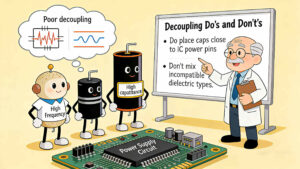
Stop guessing capacitor values! Learn how to choose the right decoupling caps for power integrity, avoid fake MLCCs, and ensure reliable PCB performance. By ChipApex FAE.
View details
Stop intermittent boot failures. Learn sequencing control, backfeed prevention, and inrush management for reliable SoC power-up.
View details
Ground potential shift during high dI/dt regen braking causes isolated CAN receivers to output false dominant states, locking EV BMS networks. Discover robust solutions like TJA1044GT/3Z + common-mode filtering validated by ChipApex.
View details
Avoid BLE dropouts, GNSS errors, and LTE sync failures with proper clock tree design. Learn layout rules, component selection, and real fixes.
View details
The activity of extra discounts on wholesale prices is in full swing…
Please fill in your contact information and we will send you the latest wholesale price list.